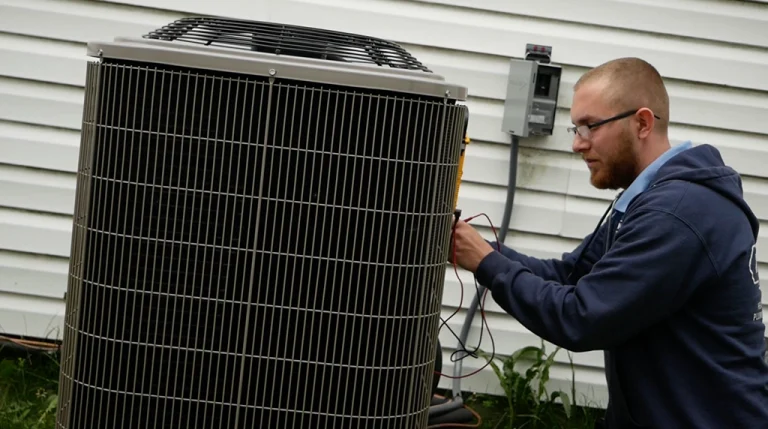

If you’re shopping for a new air conditioner or heat pump, you’ll probably hear a lot about SEER ratings.
But in 2026, there’s another term you need to know: SEER2.
SEER2 is the current efficiency rating used for new central air conditioners and heat pumps. The higher the number, the more cooling the system can provide for the electricity it uses.
So, what is a good SEER2 rating?
For many homeowners, a system in the 15–17 SEER2 range can offer a strong balance of efficiency and upfront cost. Higher-efficiency systems can go well beyond that, but the highest rating is not automatically the best choice for every home.
Your climate, how often you use your AC, the condition of your ductwork, system sizing, and your budget all matter.
What does SEER2 mean?
SEER2 stands for Seasonal Energy Efficiency Ratio 2. It measures how efficiently an air conditioner or heat pump cools your home over a typical cooling season.
The U.S. Department of Energy introduced the SEER2 rating system in 2023 along with updated testing procedures designed to better represent real-world operating conditions.
In simple terms:
Higher SEER2 = greater cooling efficiency.
A higher-rated system generally uses less electricity to provide the same amount of cooling as a lower-rated system under comparable conditions.
That can mean lower cooling costs over time, especially in homes where the AC runs frequently.
SEER vs. SEER2: What’s the difference?
SEER and SEER2 measure the same basic thing: seasonal cooling efficiency.
The difference is how the equipment is tested.
SEER2 uses updated Department of Energy testing procedures, including conditions intended to better represent the resistance an HVAC system experiences when moving air through a home’s ductwork. Because the testing method changed, you should not compare a SEER number and a SEER2 number as if they use the exact same scale.
If you’re replacing an older system, you may see its efficiency listed in SEER. When comparing new equipment in 2026, look at the SEER2 rating instead.
What is the minimum SEER2 rating in 2026?
There isn’t one minimum SEER2 rating for every air conditioner in every part of the country.
Federal standards vary based on the type of equipment and, for certain central air conditioners, where the system is installed.
Indiana and Ohio
Indiana and Ohio are part of the federal North region.
For standard split-system central air conditioners, the federal minimum is 13.4 SEER2 for equipment subject to the current standards.
Kentucky
Kentucky is part of the federal Southeast region, where requirements for split-system central air conditioners are higher.
Current minimums are:
• 14.3 SEER2 for split-system air conditioners below 45,000 BTU/h.
• 13.8 SEER2 for split-system air conditioners at or above 45,000 BTU/h.
Heat pumps
Split-system heat pumps use a national standard rather than the same regional AC requirements.
The current federal minimum for a standard split-system heat pump is 14.3 SEER2 for cooling and 7.5 HSPF2 for heating.
Your HVAC professional can confirm which efficiency requirements apply to the specific equipment being installed in your home.
So, what is a good SEER2 rating?
Meeting the minimum standard doesn’t necessarily mean you’ve found the best system for your home.
Here’s a simple way to think about your options:
• Around the minimum: An entry-level option that meets applicable efficiency requirements and may have a lower upfront cost.
• 15–17 SEER2: A strong middle ground for many homeowners looking for better efficiency without automatically moving into the highest-priced equipment.
• 18+ SEER2: High-efficiency equipment that may offer greater energy savings and often includes more advanced system technology.
These are general shopping ranges, not official federal efficiency categories.
The right number depends on how much you’ll actually benefit from the additional efficiency.
Is a higher SEER2 rating always better?
Not necessarily.
A 20 SEER2 system is more efficient on paper than a 15 SEER2 system, but that doesn’t automatically mean it’s the better investment for your home.
Consider:
• How long you plan to stay in the home. More time in the home can give you more opportunity to benefit from energy savings.
• How much your AC runs. Homes with longer or hotter cooling seasons may see more value from higher efficiency.
• Your current energy costs. Higher electricity rates can make efficiency more valuable.
• Your home’s insulation and ductwork. An efficient HVAC system can still lose performance through leaky ducts, poor airflow, or a home that loses conditioned air quickly.
• The upfront cost. The additional energy savings should make sense compared with the additional price of the equipment.
Efficiency matters, but it is only one part of choosing the right system.
How much can a higher SEER2 rating save?
The greater the difference in efficiency between two properly matched systems, the less electricity the higher-SEER2 system should need to produce the same amount of cooling under comparable conditions.
But your SEER2 rating cannot tell you exactly what your utility bill will be.
Actual savings depend on things like:
• Outdoor temperatures
• Thermostat settings
• Electricity rates
• Home size and insulation
• Duct condition
• Equipment sizing
• Installation quality
• How often the system runs
That’s why claims like “doubling your SEER rating will cut your entire energy bill in half” can be misleading. SEER2 applies to cooling efficiency, not every source of energy use in your home.
Does a furnace have a SEER2 rating?
No.
This is an important distinction if you’re replacing a complete HVAC system.
Air conditioners use SEER2 to measure seasonal cooling efficiency.
Heat pumps use SEER2 for cooling efficiency and HSPF2 for heating efficiency.
Gas furnaces use AFUE, or Annual Fuel Utilization Efficiency, to measure how efficiently they convert fuel into heat.
So if you’re comparing a complete furnace and air conditioner system, you’ll likely be looking at both an AFUE rating and a SEER2 rating.
What else should you consider besides SEER2?
SEER2 matters, but don’t shop by one number alone.
Proper system sizing
Bigger isn’t automatically better.
An HVAC system should be sized for the home’s heating and cooling needs. An oversized or undersized system can affect comfort, humidity control, efficiency, and equipment performance.
Single-stage, two-stage, or variable-speed operation
Two systems with good efficiency ratings can feel very different inside your home.
Equipment with multiple stages or variable-speed operation can adjust its output instead of operating at full capacity every time it turns on. Depending on the system, that can help maintain more consistent temperatures and humidity levels.
Installation quality
Even highly efficient equipment needs to be installed and set up correctly.
Airflow, refrigerant charge, ductwork, equipment matching, and other installation details can all affect how the system performs once it’s in your home.
Your budget
The goal isn’t to buy the biggest SEER2 number available.
It’s to find the system that gives you the right combination of comfort, efficiency, features, and cost for your home.
Are rebates available for high-efficiency HVAC systems?
They may be.
Utility companies, manufacturers, and local programs can offer rebates or incentives for qualifying high-efficiency equipment. Programs and eligibility requirements change, so check what’s currently available when you’re ready to replace your system.
Your HVAC professional can also help you identify qualifying equipment and understand which incentives may apply.
Choosing the right SEER2 rating for your home
A good SEER2 rating isn’t just the highest number on the equipment label.
It’s the rating that makes sense for your home, your comfort goals, and what you want to spend.
Start by comparing:
• The system’s SEER2 rating
• Upfront equipment and installation costs
• Expected energy use
• System features and comfort benefits
• Warranty coverage
• Your home’s heating and cooling needs
You shouldn’t have to sort through efficiency ratings and equipment options by yourself.
Peterman Brothers can evaluate your home, explain your options in plain language, and help you find a system that fits your comfort and budget.
Get an Estimate for a New HVAC System