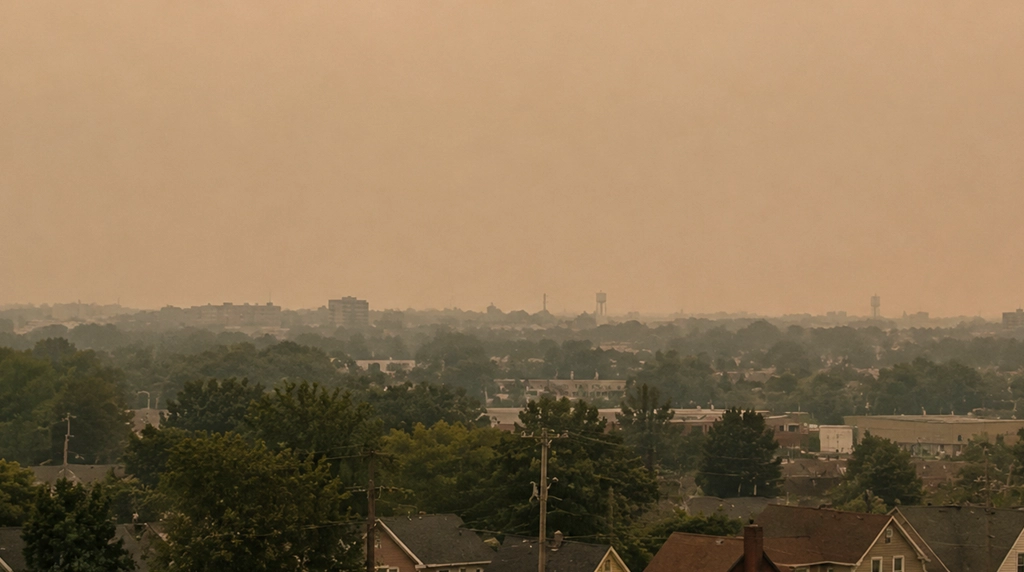
Wildfire smoke from Canada is drifting into the Midwest again, leaving hazy skies and stretches of unhealthy air across the region.
Even though the fires may be hundreds or thousands of miles away, the smoke they produce can still foul the air outside your home, and some of it works its way indoors. You cannot control which way the wind blows, but you can take real steps to cut the smoke inside your home and protect the people who live there.
Why Is Wildfire Smoke Dangerous?
Wildfire smoke is a mixture of gases and microscopic particles. One of the biggest concerns is fine particulate matter known as PM2.5, particles small enough to travel deep into the lungs.
PM2.5The fine particle that drives most smoke health effects
MERV 13Minimum filter rating the EPA recommends for smoke
AQI 101+Where sensitive groups should start limiting exposure
Exposure can cause coughing, wheezing, headaches and more. Common symptoms include:
- Coughing or wheezing
- Eye, nose and throat irritation
- Headaches
- Chest tightness
- Shortness of breath
- Fatigue
Children, older adults, pregnant people and those with asthma, COPD, heart disease or other medical conditions may be more likely to feel these effects.
Check the Air Quality Before Going Outside
The Air Quality Index, usually called the AQI, gives you a quick read on current outdoor air. You can check your local number through AirNow or your preferred weather service. Air quality shifts throughout the day as wind direction and smoke concentrations change.
What the AQI Numbers Mean
Use the index, not just how the sky looks, to decide whether it is safe outside.
101–150 · Unhealthy for Sensitive Groups. Children, older adults and people with heart or lung conditions should cut back on prolonged outdoor activity.
151–200 · Unhealthy. Everyone may begin to feel effects and should consider limiting strenuous activity outdoors.
201 or higher · Very Unhealthy or Hazardous. Reduce outdoor exposure and follow local public-health guidance.
Even when the sky does not look especially smoky, fine particles may still be in the air. Trust the AQI over visibility alone.
9 Ways to Protect Your Home During a Smoke Event
Keep Windows and Doors Closed
Opening the windows on a cool day feels good, but it lets outdoor smoke pour in. During poor air quality:
- Keep windows and exterior doors closed
- Check for damaged weatherstripping around doors and windows
- Avoid repeatedly opening exterior doors
- Close fireplace dampers when the fireplace is not in use
- Limit ventilation systems that pull outdoor air inside
Sealing obvious leaks also makes your home more comfortable and eases the load on your heating and cooling system.
Set Your HVAC System to Recirculate
Most home systems already recirculate indoor air, but some include a fresh-air intake that brings outdoor air in. If yours has one, switch it to recirculation mode or close the outdoor-air intake during a smoke event. The recirculate setting in your vehicle helps when driving through smoky conditions too.
Do not block vents or change equipment unless you know how your system is set up. A professional can help identify whether your home has an outdoor-air intake.
Check and Upgrade Your HVAC Filter
Your furnace and central air conditioner generally share the same filter, and during a smoke event it can capture some of the fine particles moving through your home. Start by inspecting your current filter and replace it if it is visibly dirty or overdue.
For better particle filtration, the EPA recommends a MERV 13 filter, or the highest-efficiency filter your system can safely handle.
Before you jump ratings: higher-efficiency filters create more resistance to airflow. A filter your system was not designed for can hurt performance or strain the equipment. Check your manufacturer’s instructions or ask a professional before a big change in filter rating, and check the filter more often during heavy smoke.
Run the HVAC Fan More Often
Your filter only cleans the air while the blower fan is running. During a significant smoke event, moving the fan from Auto to On keeps indoor air passing through the filter even when the system is not actively cooling.
Continuous operation uses more electricity and should only be used when your filter and system are in good shape. Return the fan to its normal setting once air quality improves.
Create a Cleaner-Air Room
When outdoor air gets especially bad, pick one room to serve as a cleaner-air space. A bedroom or family room with few exterior doors or windows usually works well.
To set up the room:
- Keep its doors and windows closed
- Use a portable air cleaner sized for the room
- Keep smoke-producing activities out of the space
- Run your central HVAC with an appropriate filter when possible
- Spend more time there when outdoor air is at its worst
This is especially helpful for children, older adults and people with heart or lung conditions.
Use a Portable HEPA Air Cleaner
A portable air cleaner adds filtration in bedrooms, home offices and other rooms you use often. Look for a unit with:
- A true HEPA filter
- A Clean Air Delivery Rate suited to the room’s square footage
- Replacement filters that are easy to find
- No intentional ozone generation
Place it where furniture and curtains will not block airflow, keep the door and windows closed, and run it continuously at the highest comfortable setting. Portable units clean one room or area and are not a replacement for maintaining your central system.
Avoid Creating More Indoor Pollution
When outdoor smoke is already affecting your home, skip activities that add particles or irritants to the air. Try to limit:
- Smoking or vaping indoors
- Burning candles or incense
- Wood-burning fireplaces
- Frying, broiling or other high-smoke cooking
- Aerosol sprays
- Vacuuming without a HEPA-filtered vacuum
When practical, use lower-pollution cooking methods like a microwave, slow cooker or pressure cooker. Wiping and damp-mopping surfaces removes settled particles without stirring them back into the air.
Do Not Rely on UV Lights for Smoke Removal
Some whole-home air quality systems use UV light to target certain biological contaminants. But wildfire smoke is mainly a particle-filtration problem, and UV lights do not replace a high-efficiency HVAC filter or a portable HEPA cleaner when your goal is reducing smoke particles.
Skip ozone generators
Avoid air-cleaning products that intentionally generate ozone. Ozone can irritate the lungs and make indoor air quality worse, not better.
Limit Outdoor Exposure
When the AQI is elevated, cut back on strenuous outdoor activity and move exercise indoors when you can. If you must spend extended time outside in smoky conditions, a properly fitting NIOSH-approved N95 or P100 respirator can reduce how much fine particulate matter you breathe in.
The respirator has to fit tightly around your nose and mouth to work. People with respiratory or cardiovascular conditions should follow their healthcare provider’s advice.
Watch for Smoke-Related Symptoms
Pay attention to how you and your family feel during poor air quality. People with asthma, COPD or heart disease should keep medications on hand and follow their care plans, and contact a healthcare provider if symptoms become unusual or worsen.
When to get help right away
Seek immediate medical help for severe difficulty breathing, significant chest pain or other signs of a medical emergency.
Can Your HVAC System Remove All Wildfire Smoke?
No home HVAC system can guarantee completely smoke-free air. A well-chosen filter reduces airborne particles, but it may not remove every particle, odor or gas tied to wildfire smoke. The best results come from combining several strategies.
The layered approach that works best
- Keep outdoor smoke from getting in
- Recirculate indoor air
- Use the best HVAC filter your system can safely handle
- Add portable HEPA filtration where you need it
- Reduce other sources of indoor pollution
Frequently Asked Questions
What MERV filter is best for wildfire smoke?
The EPA recommends a MERV 13 filter, or the highest-efficiency filter your HVAC system can safely accommodate, to capture the fine PM2.5 particles in wildfire smoke. Because higher-rated filters restrict airflow more, confirm your system can handle the upgrade before switching. A professional can tell you the highest rating your equipment supports.
Should I set my thermostat fan to On or Auto during a smoke event?
During heavy smoke, set the fan to On so indoor air keeps moving through the filter even when the system is not actively heating or cooling. On Auto, the fan only runs during a heating or cooling cycle, so the filter cleans far less air. Return the fan to Auto once outdoor air quality improves.
Do I need a portable air purifier if I have central HVAC?
A central system with a good filter is your whole-home baseline, but a portable HEPA air cleaner adds extra filtration in the rooms you use most, like a bedroom. Choose a unit sized for the room, with a true HEPA filter and no ozone generation. Portable units clean one area and do not replace maintaining your central system.
Will a UV light remove wildfire smoke from my air?
No. UV lights are designed to target certain biological contaminants, not the fine particles that make up wildfire smoke. Smoke is a particle-filtration problem, so a high-efficiency HVAC filter and a portable HEPA cleaner are the right tools. Avoid any device that intentionally produces ozone, which can worsen indoor air quality.
How do I check the air quality where I live?
Check your local Air Quality Index (AQI) through AirNow or your preferred weather service. Air quality can change through the day as wind and smoke shift, so check more than once during an active smoke event, and rely on the number rather than how hazy the sky looks.
Let Peterman Brothers Help You Breathe Easier
Not sure your current filter is right for your system? Concerned about your home’s indoor air quality? Our team can inspect your system, confirm the filter ratings it can safely support, and walk you through whole-home indoor air quality solutions.
Explore Indoor Air Quality Services
Ready to talk it through? Contact Peterman Brothers today and let’s improve the air inside your home.